Payment Methods:

Custom Glass Bottles

Glass communicates something no plastic can. It has weight, it has clarity, it has a permanence that tells buyers the brand inside took the product seriously. For brands whose product deserves that level of presentation, a custom glass bottle is not an upgrade , it is the right choice from the start.

Description

Why Glass Communicates Premium Before the Label Does

The moment a buyer picks up a glass bottle, something shifts. The weight communicates substance. The smooth, cool surface communicates quality of material. The clarity or color of the glass communicates intention and craft. None of these impressions require a single word on the label to land. Glass is the only primary packaging material that communicates premium through its physical properties alone, which is why the most respected beverage, cosmetic, pharmaceutical, and specialty food brands in the world continue to choose it as their primary container despite the availability of lighter, cheaper plastic alternatives.

Non-Reactive Material That Preserves Product Purity

Glass is chemically inert. It does not react with the product inside, does not absorb its compounds, and does not leach anything into it. This non-reactivity is what makes glass the material of choice for products where purity matters absolutely , premium spirits, artisan vinegars, pharmaceutical liquids, essential oils, and luxury skincare formulations all benefit from a container that makes zero contribution to the chemistry of the product it holds. For brands whose formulations are the result of real research and real craft, the inert character of glass respects that work in a way that reactive packaging materials simply do not.

Excellent Barrier Against Moisture and Air

Glass is impermeable to oxygen, moisture, and most chemical compounds. Nothing gets in and nothing gets out through a glass wall. For products where oxidation is an enemy, where moisture absorption would degrade quality, or where the retention of volatile aromatics is a product value, glass delivers a barrier that no plastic material can fully replicate. A fine whiskey, a cold-pressed oil, a concentrated fragrance , all of them stay exactly as formulated behind a glass wall for as long as the seal holds.

Shapes, Sizes and Closure Options

We offer custom glass bottles in shapes, such as round, square, flask, woozy, Boston round, decanter and special designer shapes. These bottles come in sizes from small 0.5oz samples to large 1.75 liter bottles. Our standard neck sizes, like 20-400 24-414 38-400 43-485 and 70G-450 work with corks screw caps, lotion pumps, dropper assemblies, spray atomizers and evident closures. We help you choose the shape, size and closure for your product and brand.

Hot-Fill and Cold-Fill Applications

Glass bottles work well for both fill and cold-fill production. Unlike containers, glass doesn’t change shape or break when exposed to high temperatures. For food and beverage brands that use hot-fill production glass bottles are a choice. They keep their shape and seal throughout the temperature cycle from filling to sealing to storage.

Reusable and Recyclable

Glass is an eco-friendly packaging material. It is 100% recyclable without losing quality so glass bottles can be recycled and reused to make glass. Many consumers reuse glass bottles after finishing the product, which keeps your brand in their home and shows that your product is worth keeping the bottle for. Glass bottles are good for the environment and your brand.

Label Surface and Decoration Options

The smooth, consistent surface of a glass bottle is an excellent substrate for pressure-sensitive labels, sleeve labels, screen printing, and acid-etching decoration. Each decoration method communicates a different level of brand investment and aesthetic positioning. A pressure-sensitive label communicates a practical, commercial brand. Screen printing directly onto the glass communicates premium brand investment and a decoration that cannot be removed. Acid etching communicates the highest level of luxury brand commitment.

FAQs

What shapes are available for custom glass bottles?

Round, square, flask, woozy, Boston round, decanter, and specialty designer shapes are all available across a wide range of capacities.

What neck finishes are compatible with custom glass bottles?

Standard neck finishes including 20-400, 24-414, 38-400, 43-485, and 70G-450 are available, compatible with corks, screw caps, pumps, droppers, and spray closures.

Are glass bottles suitable for hot-fill production?

Yes. Glass withstands hot-fill and cold-fill production processes without dimensional change or structural compromise.

What is the minimum order quantity?

The minimum order is 1000 units. Request your quote today.

How quickly are custom glass bottles produced?

Most orders are delivered in 10 to 12 days from artwork approval with free US shipping.

Specifications

Printing

CMYK, PMS, No Printing

Paper Stock

10pt to 28pt (60lb to 400lb) Eco-Friendly Kraft, E-flute Corrugated, Bux Board, Cardstock

Quantities

100 – 500,000

Coating

Gloss, Matte, Spot UV

Default Process

Die Cutting, Gluing, Scoring, Perforation

Options

Custom Window Cut Out, Gold/Silver Foiling, Embossing, Raised Ink, PVC Sheet.

Proof

Flat View, 3D Mock-up, Physical Sampling (On request)

Turn Around Time

6-8 Business Days, Rush

Order Process

Choose Your Custom Packaging Boxes

We have a wide range of boxes, select one or write for others.

Request a Free Instant Quote

Complete our quote form to receive a customized quote from our product specialists.

Finalize Your Order

After getting the awesome price, just say print it!

Time to Make a Custom Dieline

We will help you with completely custom dielines according to your needs

Get Creative with Artwork

Collaborate with our design experts for you top notch artwork

Visualize Your Packaging with Mockups

We will send you 3D mockups of your print ready packaging

Roll-on Production!

After approving everything, sit back and relax, while we produce

Artwork Preparation Guide

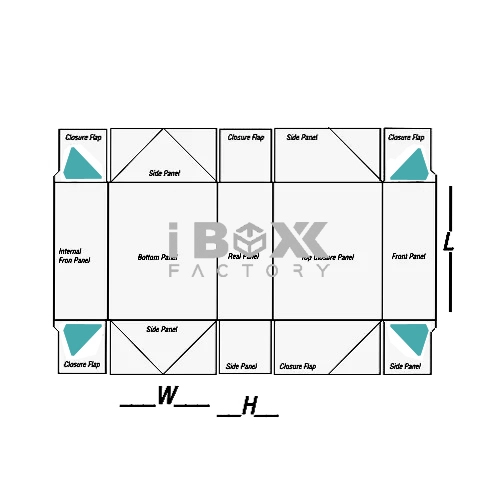
Cut Line (Black Line)

Indicates the cut at its final size. Important artwork and text should be placed at least 0.125 inches inside of the cut line.

Perforation (Dotted Black Lines)

Perforation line refers to paper that is punched with very small holes to allow the paper to be torn and folded easily.

Bleed Line (Red Lines)

Indicates where the bleed line is located. Any artwork which goes to the cut line should be extended to the bleed line to get a seamless print.

Crease Line (Green Lines)

Indicates where the product is to be folded.

Safety Margin (Dotted Green Lines)

Indicates where artwork and text should safely be placed inside. As an industry standard, all artwork should at least be placed 0.125 inches away from the cut line unless your design is intentional.

Customer Reviews